Business payment roles
This guide covers Business Commerce for registered companies and sole traders. Applications are available for MK, AL, RS and BA. Natural persons use the separate Individual MoR guides. Booking and Rent-a-Car follow distinct workflows.
Several parties take part when a customer pays through Kordiva. The most important rule is simple: your business remains the seller of the product or service.
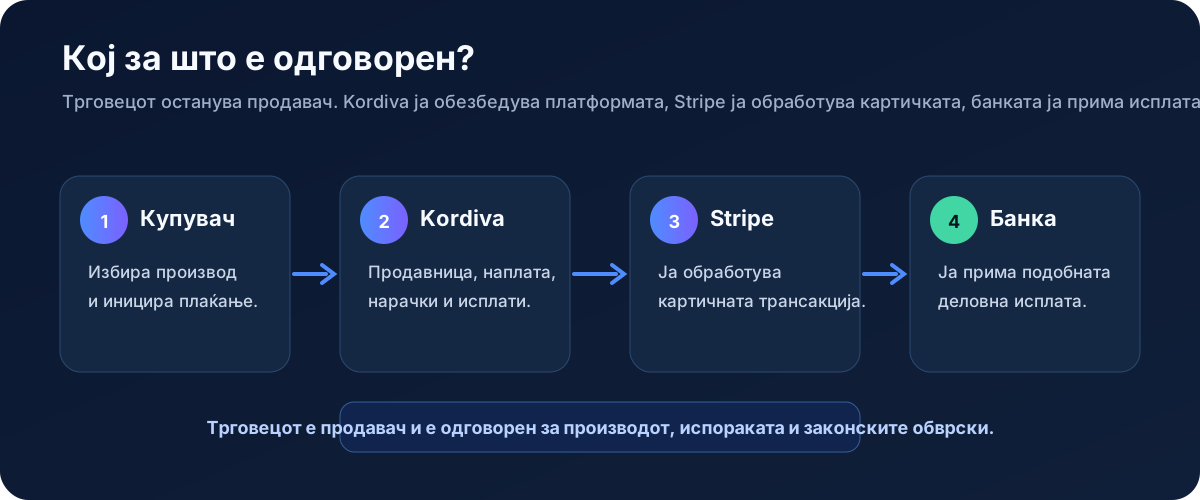
The merchant is the seller
Section titled “The merchant is the seller”The merchant remains responsible for:
- product accuracy, description, and price;
- fulfillment and delivery;
- return and refund policies;
- warranties and customer rights;
- tax treatment;
- legally required documents and information.
The merchant’s legal details should be accurate and accessible in the storefront.
What Kordiva does
Section titled “What Kordiva does”Kordiva provides the E-commerce platform and connects the selling flow:
- online storefront and merchant dashboard;
- Checkout Links;
- API integration;
- Stripe connection;
- order and payment records;
- refund and dispute functionality;
- payout-eligibility checks.
Kordiva does not become the owner, manufacturer, or supplier of the merchant’s product.
What Stripe does
Section titled “What Stripe does”Stripe provides the payment infrastructure and processes the card transaction.
Kordiva uses Stripe Connect to connect the merchant to the payment flow inside Kordiva.
What the bank does
Section titled “What the bank does”Once funds are eligible for payout, the merchant’s business bank receives the payout.
A successful card payment and a bank payout are different stages. For timing and eligibility, see Payments & Payouts.
What the customer should see
Section titled “What the customer should see”The customer should clearly understand which business is selling the product. The storefront and checkout should therefore show accurate:
- business name;
- support contact;
- product description;
- price and currency;
- terms of sale;
- return and refund policy.